Southlake, TX · Garage Door Service
Westlake's newer homes run circuit-board openers, not old chain drives. Southlake Garage Door Pros diagnoses logic board and sensor faults 4 miles out.
Westlake is small - about 510 households - and the houses went up recently, with a median build year around 2010. That matters more than the town's size does on its own. A cluster that tight, built that late, means the openers inside those garages are almost all circuit-board units from the start: safety photo-eyes, learn-button remotes, logic boards running the whole show. There's very little of the old chain-drive-and-relay hardware you'd find in a neighborhood built decades earlier.
The job goes sideways when a tech shows up assuming the fix is mechanical - a worn gear, a stripped sprocket - and it turns out to be a board fault instead. Those two failures look almost identical from the driveway: door won't respond, or it runs partway and stops. But one is a five-minute part swap and the other means pulling the opener apart to test the board, and sometimes calling the manufacturer to check if it's still under warranty before touching it. Compare that to Southlake itself, where the housing stock spans 1953 to 2014 - older doors there still turn up with tired chain drives and worn-out relay switches that Westlake, being newer overall, mostly doesn't have.
Getting the diagnosis wrong at the door costs everyone time, so the first ten minutes on a Westlake call are spent ruling out the board before anything else gets touched.
We run this call out of Southlake, about 4 miles from Westlake, so there's no separate depot or crew stationed in town - just a shorter drive than most of the rest of the service area. That's the only claim we'll make about timing; we're not going to promise a response window we can't back up.
Once the truck's in the driveway, the time split looks different than it does on an older opener. There's no tearing into a gearbox packed with decades of grease. The diagnostic step is mostly electronic: pull any blink codes off the unit, test the safety sensor circuit, check whether the logic board is throwing a fault or just not getting power. That's usually faster than the mechanical teardown an older chain-drive opener needs, right up until the board itself is the problem - then the clock depends on whether we're carrying a compatible replacement board on the truck or need to order the exact one for that opener model.
We won't quote a fixed number of hours here, because whether the part's on hand is the real variable, not the drive time.
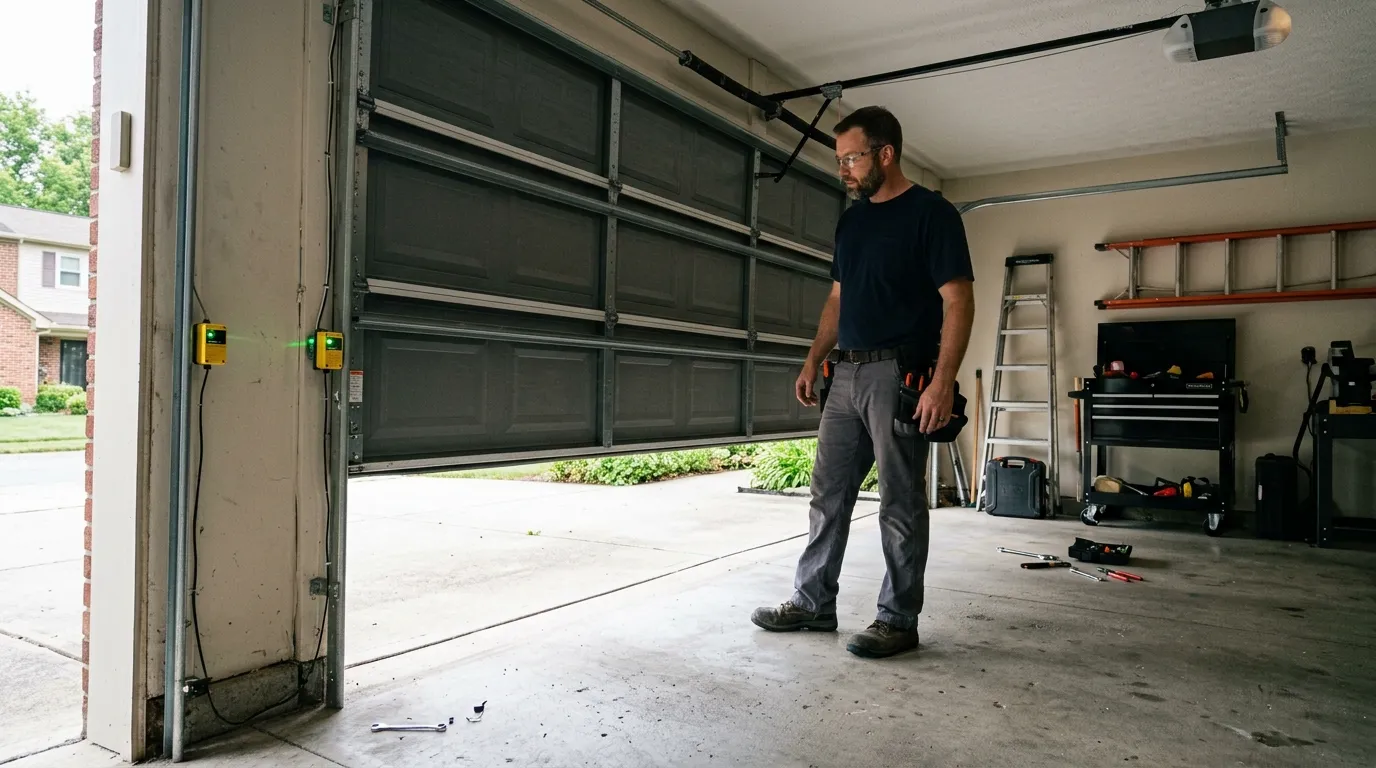
The complaint we hear most from this side of town isn't a door that won't budge - it's a door that half-works. The opener hums, the motor spins, but the door doesn't travel, or it starts up and reverses immediately like something's blocking it when nothing is. On a newer board-controlled unit, that's rarely a mechanical jam. It's usually the safety sensor pair at the bottom of the tracks reading a false obstruction, or the logic board losing communication with the motor mid-cycle.
Another version: the wall button opens the door fine, but the remote does nothing, or works only sometimes. On an older relay-based system that's a wiring problem nine times out of ten. On a 2010-era board-and-remote setup, it's more often the receiver antenna, the remote's rolling code falling out of sync, or a board that's dropping the signal intermittently before it fails for good.
We're not going to tell you it's always one or the other - the honest answer is you can't tell from the symptom alone which of the two you've got until someone puts a meter on the board and checks the sensor alignment by hand.
Once the sensor pair is confirmed aligned and clean, and the wiring checks out, the fix comes down to the board. If it's a bad connection or a blown fuse on the board itself, that's a same-visit repair. If the board has actually failed, replacement is the real fix - these units don't have serviceable circuit boards you patch, you swap the whole board or, depending on the opener's age and model, the whole unit.
Here's the honest limitation: proprietary logic boards for some opener brands aren't something we carry for every model on the truck, and ordering the exact one can take a few days. On a unit that's still fairly new - which most of what's in Westlake is, given the 2010 median build year - replacing just the board usually makes more financial sense than replacing the whole opener. That flips on an older unit where the drive mechanism is also near the end of its life; then a full opener swap is the better call, and we'll say so rather than sell a board repair on a unit that's going to need more work in a year anyway.
See more on opener repair coverage from Southlake or check other Westlake service notes.
On a newer board-controlled opener like most in Westlake, that's usually the safety sensors at the bottom of the tracks reading a false obstruction, or the logic board losing sync with the motor - not a mechanical jam. We check sensor alignment and wiring first, then test the board before assuming anything needs replacing.
No. We run out of Southlake, about 4 miles away, and cover Westlake from there. There's no separate depot in town, so we won't promise a response window tied to a local branch - just note that the drive is shorter than for most of the service area.
Depends on the unit's age. Given Westlake's newer housing stock - median build year around 2010 - most openers here are young enough that a board swap alone makes sense. On an older unit where the drive mechanism is also worn, replacing the whole opener is usually the better move, and we'll tell you which situation you're in.
On board-and-remote setups common in newer builds, that's often the receiver losing the remote's rolling code, a failing antenna on the board, or intermittent board failure. It's rarely the wiring, which is the more common cause on older relay-based openers.
Call or request a quote - tell us what your door is doing and where you are.