Southlake, TX · Garage Door Service
Trophy Club's houses date mostly from 2000 onward, so the hardware and failure points differ from older Southlake stock. We cover repair and install here, 3 miles out.
Trophy Club sits about 3 miles from our shop in Southlake, so the drive isn't the variable here - the housing era is. Most of this town went up right around 2000, which is late in the region's build-out window (the wider area spans 1953 to 2014). That matters for a service call because a house from 2000 almost always has factory torsion spring setup, a steel or composite door, and an opener with a circuit board rather than the old relay-and-screw-terminal kind. Diagnosing those takes less guesswork than on an older door where the hardware may have been swapped twice by two different owners. A stuck opener or a spring that's lost tension on a 2000-era door usually points to one of two or three known failure points, not a mystery. That's the honest upside of a town built in one narrow window - the fixes are more predictable. The trade-off is that when something on this generation of door does fail, replacement parts sometimes have to be ordered rather than pulled off the truck, since the hardware isn't the decades-old universal stuff every supplier still stocks.
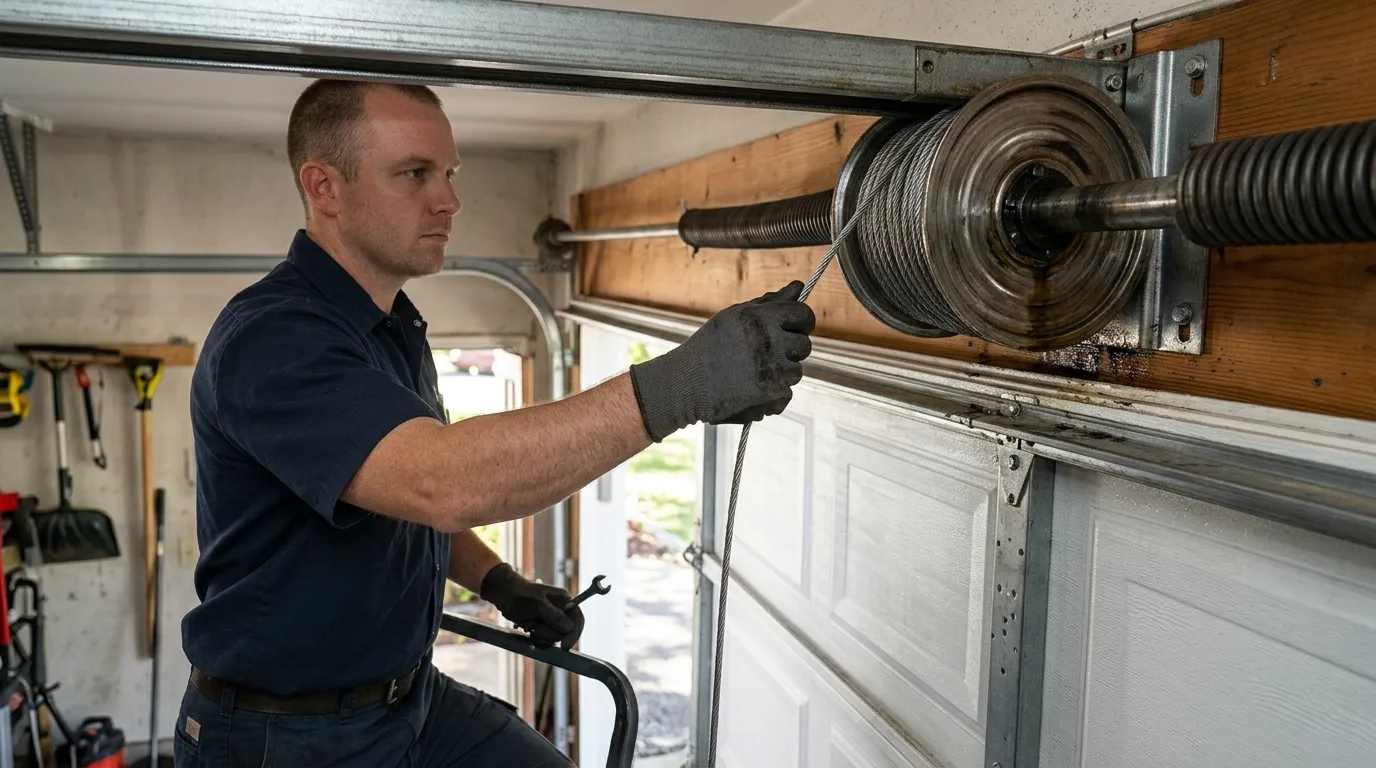
A torsion spring job on a Trophy Club door is not a good DIY project regardless of the house's age - the spring is under enough tension to break a bone, and that hasn't changed since 2000. What you can reasonably do yourself: check the photo-eye alignment, clean and lubricate rollers and hinges, tighten loose bolts on the track brackets, and replace worn weatherstripping. Those are low-risk jobs on any door built in this era, because the parts are standard and accessible. What you should not do yourself is anything involving the torsion spring, the cables, or opening up the opener's logic board housing to chase a wiring fault. On a 2000-era door specifically, one thing homeowners get wrong is assuming the opener's circuit board is field-repairable the way an older chain-drive relay setup was - it usually isn't, and swapping the board (or the whole unit) is the real fix. If you're not sure whether a symptom is a $20 part or a spring under 200 pounds of stored force, that's the line where a call beats a guess.
The failure most specific to a Trophy Club-era door is opener electronics, not the mechanical hardware. Houses built around 2000 came with early digital openers - logic boards, keypad entry, sometimes a rolling-code remote system - and after two decades those boards are past their expected service life even if the motor and gears are fine. Homeowners often call about a "dead" door when the actual problem is a board that's failed intermittently for months, not the springs or the track. The other place this goes sideways: because the region's climate band here runs moderate heat rather than extreme, insulated doors on these houses haven't taken the thermal stress that causes seal and panel warping in hotter climates - so when a panel does warp or a seal does fail on a door this age, it's more often installation-grade material than climate fatigue, and worth flagging to whoever sold the door originally. We won't chase an intermittent electrical fault for hours without a clear diagnostic step - if it's not repeating, we tell you that up front rather than billing time against a guess.
We don't have a fixed price list to quote here, and giving you one without seeing the door would be a guess dressed up as a fact. What drives cost on a Trophy Club job is usually the same short list: whether the part is a stock item or has to be ordered for a 2000-era opener board, whether it's a single spring or a matched pair on a double door, and whether the fix is a repair or has crossed the line into a full opener or door replacement. Given the income profile in this part of the service area - median household income runs well above the wider area's $119,803 - we more often see homeowners choose full replacement with upgraded insulation or a quieter belt-drive opener rather than a patch repair on an aging board. That's a homeowner's call to make, not ours to push. Ask for the breakdown between parts and labor before you agree to anything, and ask specifically whether a part is on the truck or needs ordering - that second answer changes your timeline more than it changes the price.
Across the wider service area there are roughly 64,328 households and about 44,702 owner-occupied houses, spanning building years from 1953 to 2014 - most of that stock skews to the 2000s. Trophy Club itself, with roughly 4,784 households, sits at the newer end of that range, built right around 2000. That narrow build window is exactly why a generic garage door page doesn't serve this town well: a fault common in a 1970s neighborhood - brittle single-strand cable, an original one-piece door on side-mount hardware - simply doesn't exist here. What does show up is opener electronics reaching end of service life at roughly the same time across many houses, because they were installed in the same few years. When one homeowner's board fails, it's a reasonable bet the neighbor's is close behind. That clustering is the local reality worth knowing before you decide whether to repair or replace.
About 3 miles. We cover Trophy Club as part of our wider Southlake-based service area, alongside towns like Westlake and Roanoke.
Generally yes. Most of Trophy Club was built right around 2000, which is on the newer end of the region's 1953-2014 build range. That means factory torsion hardware and digital openers rather than older relay-based systems.
On houses built around 2000, the most common cause is the opener's logic board reaching end of service life, not a mechanical spring or cable failure. Boards from that era often fail intermittently before they fail completely.
Depends on the part and the board. We check whether it's a stock part or one that has to be ordered, and give you both the repair cost and a replacement option so you can compare - we don't push replacement by default.
Call or request a quote - tell us what your door is doing and where you are.