Southlake, TX · Garage Door Service
We drive 14 miles from Southlake to fix garage doors in Corinth, where most houses date to 1997 and springs wear out after two decades of heat and daily use.
Corinth sits at the same 14-mile mark from Southlake as Saginaw and and that drive shapes what we load on the truck before we ever get a call. Most houses on this side of Corinth went up around 1997, which puts the neighborhood a few years ahead of the broader service area's median build year of 2000 but still squarely inside the 1953-2014 window we see across the region. That means torsion springs sized for standard 7-foot sectional doors, steel rollers, and the same handful of opener logic boards that show up in nearly every subdivision from that stretch of the late 1990s. We carry those on the truck because we know we'll need them before we're halfway down the road. What we don't carry, and won't pretend: obsolete extension-spring hardware from the handful of older outliers, or panel colors that got discontinued a decade ago. Those jobs need a special order, and we tell you that on the phone, not after we've already made the drive.
The climate band for this part of Texas runs moderate heat, and that's the quiet reason so many Corinth service calls turn out to be springs rather than openers. A torsion spring rated for a specific door weight loses tension a little faster every summer it spends cycling in a hot garage, and a door that lifted fine in March starts binding or slamming by August. On a lot of the 1997-era houses out here, that spring has never been touched, because nobody thinks about it until the door won't open. The other place this goes sideways is the opener sensor pair - dust and heat expansion knock the alignment off by a hair, and the door reverses for no reason anyone can see standing in the driveway. Neither of those is dramatic until the day the spring actually snaps under load, usually while someone's mid-cycle with the door half up. That's the call that can't wait, and it's also the one where guessing at the fix over the phone doesn't help anyone.
Some of what turns up on a Corinth service call is fine to handle yourself. Realigning a photo-eye sensor, tightening loose track bolts, lubricating rollers on a door that's just gotten noisy - none of that needs a truck. What isn't a DIY job is anything involving the torsion spring itself. A wound spring on a standard door carries enough stored force to break a wrist or worse if the winding bars slip, and there's no safe way to learn that on the fly. Cable replacement is the same story - a frayed cable under tension doesn't give you a warning. If your opener motor runs but the door won't move, that's usually a stripped gear or a broken drive belt inside the unit, which is a straightforward swap but still means opening the housing on a powered machine. Our honest limit here: we don't walk people through spring jobs over the phone, no matter how careful they say they'll be. It's the one repair on this list we won't talk anyone into doing solo.
There's no branch in Corinth - every call here runs the 14 miles out from Southlake, so what you're booking is a scheduled trip, not a walk-in. That's worth knowing before you call: we're not going to promise a number of minutes we can't back up, and we won't invent one. What we can tell you is that the drive is a known, fixed distance, which means once a job's on the schedule for this side of town, the timing doesn't slip the way it might for a call further out. If you're weighing whether it's worth booking now versus waiting, a door that's making noise but still opening is a different priority than one that's stuck or won't move at all - tell us which on the call so we can plan the trip right. You can see the areas we run from Southlake at /near/corinth/, and if the job you actually need is something other than a repair - a full replacement, an opener swap - the /garage-door-repair-southlake-tx page covers the rest of what we do.
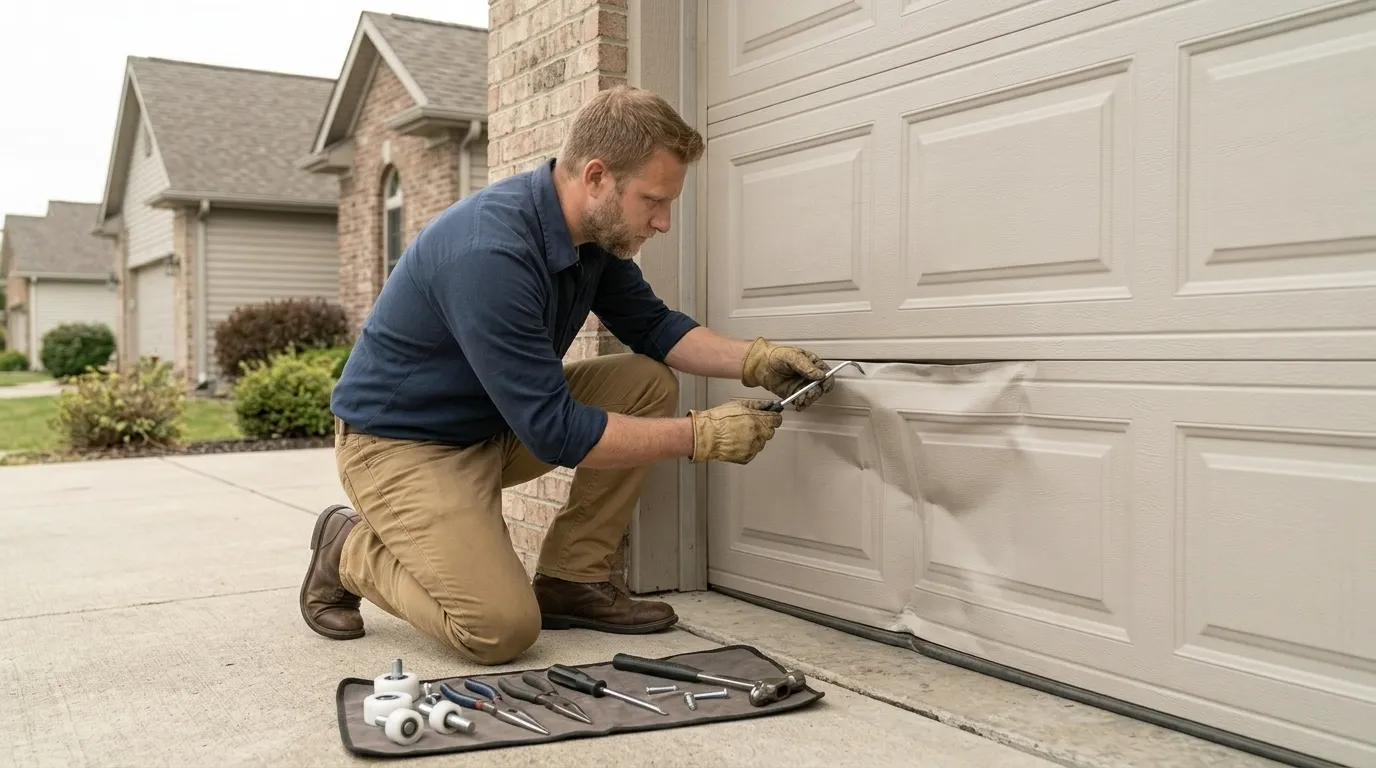
A torsion spring replacement on a standard 1997-built Corinth garage starts with unloading the door - clamping it in place so the spring can be safely unwound, since that's where nearly all the stored force in the system sits. From there it's out with the old spring, in with one matched to the door's actual weight (not just whatever was on the shelf), and a full cycle test before we call it done, checking balance at several points on the track rather than just watching it go up once. Cable jobs run similar: both cables get replaced together even if only one broke, because a mismatched pair wears unevenly and you're back to square one in a year. Opener repairs vary more - sometimes it's a $30 sensor, sometimes the logic board's shot and the unit's simple to replace outright. We'll tell you which one you're looking at before we start, not after, so you're deciding on real numbers rather than guessing.
Corinth is about 14 miles from our shop in Southlake, the same distance as the run out to Saginaw. There's no local branch here - every job is a scheduled trip from Southlake, which we're upfront about when you call to book.
Yes. Torsion springs sized for standard sectional doors from that era are common and we stock them on the truck. Where it gets slower is with older extension-spring setups or discontinued panel styles, which sometimes need a special order.
Very normal. A spring's rated for a number of open-close cycles, not a calendar date, and heat speeds that wear along. A door that used to lift smoothly and now feels heavy or slams shut is usually telling you the spring's near the end of its life.
Yes, that's a safe DIY fix - loose track brackets are just bolts, no stored tension involved. Where we draw the line is the spring and cables; those carry enough force to cause a serious injury if something slips while you're working on them.
Call or request a quote - tell us what your door is doing and where you are.